what term refers to different forms of the same gene?
Glossary of Terms
A B C D Eastward F Yard H I J K L Grand North O P Q R Due south T U 5 West X Y Z
Select the first letter of the word you are seeking from the list in a higher place
to spring to the advisable department of the glossary or scroll down to it
- A -
- albinism

- the genetically inherited condition in which in that location is a marked deficiency of pigmentation in skin, pilus, and eyes. An private with these traits is an "albino." Since the factor for albinism is recessive, it merely shows up in the phenotype of homozygous recessive people. This is a pleiotropic trait.
- alleles
- alternate forms or varieties of a gene. The alleles for a trait occupy the same locus or position on homologous chromosomes and thus govern the aforementioned trait. However, because they are different, their action may result in unlike expressions of that trait.
- amino acids
- small molecules that are the components of proteins. There are 20 different kinds of amino acids in living things. Proteins are composed of dissimilar combinations of amino acids assembled in chain-like molecules. Amino acids are primarily composed of carbon, oxygen, hydrogen, and nitrogen.
- Angelman syndrome
- a rare genetically inherited form of mental retardation due to the deletion or inactivation of specific genes on chromosome 15. The inheritance of this syndrome is subject to genome imprinting. Children with Angleman syndrome typically besides accept small heads, experience seizures, have pronounced spoken communication damage, are hyperactive, and have rest disorders.
Dorsum to Top
- B -
- blending theory
- an incorrect 19th century theory about the inheritance of characteristics. It proposed that inherited traits blend from generation to generation. Through his institute cross-breeding experiments, Gregor Mendel proved that this was wrong
Dorsum to Top
- C -
- carrier
- an individual who is heterozygous for a trait that only shows up in the phenotype of those who are homozygous recessive. Carriers often practice not testify any signs of the trait merely tin can pass information technology on to their offspring. This is the case with hemophilia.
- cataract
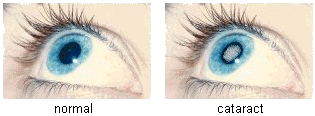
- an impairment of vision acquired by the lenses of the eyes becoming cloudy. Cataracts are mutual in elderly people. They may exist inherited or acquired by diabetes and environmental factors.
-
- chronic disease
- an disease that lasts for a long period of time or indefinitely. In contrast, an acute illness is 1 with a rapid onset and a short but ordinarily severe course.
- chromosomes
- thread-like, gene-carrying bodies in the nucleus of a cell. Chromosomes are composed primarily of DNA and protein. They are visible simply nether magnification during certain stages of cell segmentation. Humans accept 46 chromosomes in each somatic prison cell and 23 in each sex jail cell.
- codominance
- the situation in which two different alleles for a trait are expressed unblended in the phenotype of heterozygous individuals. Neither allele is dominant or recessive, then that both appear in the phenotype or influence it. Blazon AB blood is an example. Such traits are said to be codominant.
- cantankerous-pollination
- the mating of two genetically dissimilar plants of the same species. Normally, the term is used in reference to the crossing of two pure breeding (homozygous) plants.
- cystic fibrosis
- a genetically inherited disease in children that results in chronic fluid development in the lungs, making breathing difficult. This illness also prevents normal assimilation of fats and other nutrients from food. Cystic fibrosis occurs as a consequence of inheriting a recessive allele for it from both parents. This is ultimately a fatal disease, but with modern medical care, about 2/3 of the people with it survive into early adulthood. About 30,000 people have cystic fibrosis in the U.S. today.
Dorsum to Tiptop
- D -
- diabetes
- an inherited metabolic disorder in which there are abnormally high claret sugar levels. In advanced stages, this oftentimes results in blindness from cataracts, nerve impairment, gangrene in the feet and legs leading to amputation, centre illness, and kidney failure. Type one diabetes melitis (juvenile onset diabetes) is due to decreased production of insulin by the pancreas. Type 2 diabetes melitis is due to increased resistance of cells in the body to insulin. The gene or genes for diabetes are incompletely penetrant.
- dominant allele
- an allele that masks the presence of a recessive allele in the phenotype. Dominant alleles for a trait are commonly expressed if an private is homozygous dominant or heterozygous.
- Dna (deoxyribonucleic acrid )
- a large organic molecule that stores the genetic lawmaking for the synthesis of proteins. DNA is equanimous of sugars, phosphates and bases arranged in a double helix shaped molecular construction. Segments of DNA in chromosomes correspond to specific genes.
Dorsum to Top
- E -
- development
- genetic change in a population of organisms that occurs over time. The term is as well frequently used to refer to the advent of a new species.
Dorsum to Top
- F -
- f1 generation
- the first offspring (or filial) generation. The next and subsequent generations are referred to equally f2, f3, etc.
- fragile-X syndrome
- a relatively common genetically inherited abnormality of the X chromosome which results in mental retardation. Since information technology is an 10-linked trait, males more oft accept it expressed in their phenotypes. Most fragile-X males have large testes, big ears, narrow faces, and sensory integration dysfunctions that result in learning disabilities. It is probable to occur 1 in 1000 births. Approximately 1 in 700 females are carriers of the gene for this trait.
Back to Elevation
- K -
- gene flow
- the transference of genes from ane population to some other, usually equally a consequence of migration. The loss or addition of individuals can easily change the gene pool frequencies of both the recipient and donor populations--that is, they can evolve.
- cistron pool
- all of the genes in all of the individuals in a breeding population. More precisely, it is the collective genotype of a population.
- genes
- units of inheritance usually occurring at specific locations, or loci, on a chromosome. Physically, a gene is a sequence of Deoxyribonucleic acid bases that specify the order of amino acids in an unabridged protein or, in some cases, a portion of a protein. A cistron may exist made up of hundreds of thousands of DNA bases. Genes are responsible for the hereditary traits in plants and animals.
- genetic drift
- evolution, or change in cistron pool frequencies, resulting from random chance. Genetic drift occurs most speedily in small populations. In big populations, random deviations in allele frequencies in i management are more than probable to be cancelled out past random changes in the opposite direction.
- genetics
- the study of gene structure and action and the patterns of inheritance of traits from parent to offspring. Genetic mechanisms are the underlying foundation for evolutionary change. Genetics is the branch of science that deals with the inheritance of biological characteristics.
- genome
- the full genetic complement of an private (or of a species). In humans, it is estimated that each individual possesses approximately 2.ix billion base units in his or her Deoxyribonucleic acid. Come across Human Genome Project.
- genome imprinting
- an inheritance design in which a gene volition accept a unlike upshot depending on the gender of the parent from whom it is inherited. Genome imprinting is also known as genetic imprinting.
- genotype
- the genetic makeup of an private. Genotype tin can refer to an organism's entire genetic makeup or the alleles at a detail locus. See phenotype.
- gout
- a genetically inherited metabolic disorder in which in that location is an imbalance of uric acid in the blood which causes a build upwardly of urates in joint areas. Symptoms include painfully inflamed joints, specially of the anxiety and hands, that can become chronic and consequence in deformity. Unremarkably, just one joint is involved, most commonly the base of a big toe. Gout is a sex-controlled trait, usually being more severe in men.
Dorsum to Peak
- H -
- hemophilia
- an X-linked genetically inherited recessive disease in which one or more of the normal blood clotting factors is not produced. This results in prolonged haemorrhage from even minor cuts and injuries. Bloated joints caused by internal bleeding is a mutual problem for hemophiliacs. Hemophilia most ofttimes afflicts males.
- heterozygous
- a genotype consisting of ii different alleles of a gene for a particular trait (Aa). Individuals who are heterozygous for a trait are referred to as heterozygotes. See homozygous.
- HLA system
- the body's genetically inherited system for recognizing and rejecting foreign tissues, such as transplanted organs. The HLA system has the most genes of any other known human multiple-allele series. At that place are at least 30,000,000 possible HLA genotypes. HLA stands for "human leukocyte antigen" .
- homeotic gene
- run across regulator gene.
- homologous chromosomes
- chromosomes that are paired during the production of of sex cells in meiosis. Such chromosomes are alike with regard to size and also position of the centromere. They also have the same genes, simply not necessarily the same alleles, at the aforementioned locus or location.
- homozygous
- having the same allele at the same locus on both members of a pair of homologous chromosomes. Homozygous also refers to a genotype consisting of two identical alleles of a gene for a particular trait. An individual may exist homozygous ascendant (AA) or homozygous recessive (aa). Individuals who are homozygous for a trait are referred to equally homozygotes. See heterozygous.
- Human Genome Project
- a multinational research effort designed to identify and map the location of all human genes. The idea of a Homo Genome Projection began at a 1984 international conference in Utah. Research to decode the homo genome began in earnest in 1986, funded past the U.Southward. Department of Free energy. The initial stage of discovering all human DNA codons was completed early in 2001 at a price of two.7 billion dollars. The next phase of research volition exist to identify the proteins for which these genes code. This decoding of the human proteome will be an fifty-fifty more daunting job than the original Human Genome Project. See genome.
- Huntington'due south disease
- a severe genetically inherited fatal degenerative nerve disorder. The symptoms usually do not appear until early on middle age. There is a progressive loss of muscle control that inevitably leads to paralysis and death. This disease is likewise called Huntington'south chorea .
- hybrids
- offspring that are the result of mating between two genetically different kinds of parents--the opposite of purebred.
Dorsum to Height
- I -
- incomplete penetrance
- the situation in which an allele is expressed only if certain factors are present in the environment. The triggering of genetically inherited diabetes by obesity and maybe astringent emotional stress is an example.
- intermediate expression
- the situation in which a heterozygous genotype results in a phenotype that is intermediate between those resulting from the homozygous genotypes. The mid-range baritone male vox is an instance.
Back to Top
- J -
Dorsum to Height
- Grand -
Back to Tiptop
- L -
Dorsum to Top
- M -
- meiosis
- cell division in specialized tissues of ovaries and testes which results in the product of sperm or ova. Meiosis involves ii divisions and results in 4 daughter cells, each containing only half the original number of chromosomes--23 in the instance of humans.
- Mendelian genetics
- inheritance patterns which can be explained by simple rules of dominance and recessiveness of genes.
- modifying gene
- a gene that can change the expression of another gene in the phenotype of an individual.
- monozygotic twins
- identical twins. Twins that come from the same zygote are essentially the same genetically. Differences between monozygotic twins afterwards in life are virtually always the effect of environmental influences rather than genetic inheritance. Fraternal twins may look similar but are not genetically identical.
- multiple-allele serial
- a situation in which a factor has more than ii alleles. The ABO blood blazon system is an instance. Multiple-allele serial merely partly follow simple Mendelian genetics.
- multiple sclerosis (MS)
- a genetically inherited progressive disease of the central nervous system. MS occurs as a consequence of one's own allowed system attacking the insulating sheath that normally protects neurons. Symptoms range from numbness and tingling to paralysis. There is a loss of motor and cognitive functions. The factor(south) responsible for MS are incompletely penetrant in that the onset of the illness is obviously triggered by a virus and peradventure other environmental factors. At that place is a correlation between the amount of sunlight that children are exposed to and the likelihood that they volition develop MS subsequently in life. People who spend much of their first sixteen years in tropical and subtropical regions of the world are much less likely to develop this illness than those who live in far northern and far southern regions of our planet. It is believed that the lack of abundant sun exposure early in life is somehow responsible for the later on onset of MS.
- muscular dystrophy (Doctor)
- whatsoever of a group of inherited progressive musculus disorders caused past a defect in one or more genes that command muscle function. MD is characterized by a gradual, irreversible wasting of skeletal muscle. It is a sex-linked trait about often passed on to sons by their mothers. The most mutual form, Duchene Medico, begins to weaken the legs of boys by age 3 and inevitably gets worse with each passing year. There is no cure for this disorder, and it usually results in decease earlier the age of 30.
- mutation
- an amending of genetic fabric such that a new variation is produced. For instance, a trait that has only ane allele (A) can mutate to a new form (a). This is the simply mechanism of evolution that can produce new alleles of a cistron.
Back to Acme
- N -
Back to Height
- O -
- ovum (plural ova )
- a female person sex activity prison cell or gamete.
Back to Superlative
- P -
- pangenesis
- Charles Darwin'southward wrong theory almost the inheritance of traits. He proposed that hereditary particles in the torso are affected by the things an individual does during his or her lifetime. These modified particles were thought to drift via blood to the reproductive cells and subsequently could be inherited by the next generation. This was a variation of Lamarck's wrong idea of the "inheritance of acquired characteristics."
- phenotype
- the observable or detectable characteristics of an individual organism--the detectable expression of a genotype.
- pleiotropy
- the situation in which a unmarried gene is responsible for a variety of traits. The commonage group of symptoms known as sickle-cell trait is an example.
- polygenic trait
- an inherited trait that is determined by genes at two or more loci. Simple Mendelian rules of dominance do not use to the complex interaction of these genes. As a result, phenotypes may appear as apparent blends or intermediate expressions. Homo peel and pilus color are polygenic traits. Many polygenic traits are besides influenced by environmental factors.
- principle of contained assortment
- Gregor Mendel's second principle of genetic inheritance. It states that different pairs of genes are passed to offspring independently and so that new combinations of genes, present in neither parent, are possible. In other words, the distribution of i pair of alleles does not influence the distribution of another pair. The genes decision-making dissimilar traits are inherited independently of one another.
- principle of segregation
- Gregor Mendel's first principle of genetic inheritance. It states that, for any particular trait, the pair of genes of each parent separate (during the formation of sex cells) and only ane factor from each parent passes on to an offspring. In other words, genes occur in pairs (because chromosomes occur in pairs). During gamete product, the members of each gene pair separate, so that each gamete contains 1 fellow member of each pair. During fertilization, the full number of chromosomes is restored, and members of gene pairs are reunited.
- probability
- the likelihood that a specific event will occur. Probability is ordinarily expressed as the ratio of the number of actual occurrences to the number of possible occurrences.
- proteins
- any of a large number of circuitous organic molecules that are composed of one or more than chains of amino acids. Proteins tin serve a wide variety of functions through their power to demark to other molecules. Proteins may be enzymes, hormones, antibodies, structural components, or gas-transporting molecules.
- proteome
- the full complement of proteins produced by an private (or a species). Information technology is estimated that each human produces approximately xc,000 types of proteins. See Man Genome Projection.
- psoriasis
- an inherited disease characterized by recurring thick, crimson patches of inflamed skin. It affects men and women every bit. This trait is subject to genome imprinting.
- Punnett foursquare
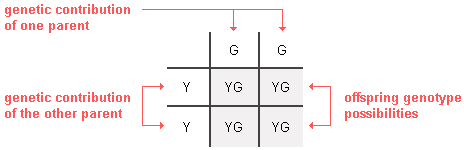
- a simple graphical method of showing all of the potential combinations of offspring genotypes that tin occur and their probability given the parent genotypes. Run into example below. Punnett squares are commonly used by genetics counselors to predict the odds of a couple passing on particular inherited traits.
-
- purebred
- offspring that are the result of mating betwixt genetically similar kinds of parents--the contrary of hybrid. Purebred is the same as true breeding.
Back to Pinnacle
- Q -
Back to Height
- R -
- recessive allele
- an allele that is masked in the phenotype by the presence of a ascendant allele. Recessive alleles are expressed in the phenotype when the genotype is homozygous recessive (aa).
- regulator gene
- a gene that tin can initiate or block the functions of other genes. Regulator genes command the timing of production of a variety of chemicals in humans and other organisms. Soon after conception, regulator genes work every bit master switches orchestrating the timely development of our body parts. They are too responsible for changes that occur in our bodies as we grow older. Regulator genes are likewise called homeotic genes.
Dorsum to Top
- S -
- sexual practice cell
- a gamete, either a sperm or an ovum. Sex cells are produced by the meiosis process. See somatic cell.
- sex-controlled cistron
- a gene that can be inherited past both genders but is unremarkably expressed differently in males and females. See sex-limited gene.
- sex-express gene
- a gene that can be inherited by both genders but is commonly expressed in but males or females. See sexual practice-controlled gene.
- sickle-cell trait
- a genetically inherited recessive condition in which red blood cells are distorted resulting in severe anemia and related symptoms that are oft fatal in babyhood. Sickle-cell trait is the result of a pleiotropic factor. Sickle-jail cell trait is also known equally sickle-cell anemia.
- somatic cell
- any jail cell in the body except those directly involved with reproduction. Virtually cells in multicellular plants and animals are somatic cells. They reproduce by mitosis. See sex cell.
- sperm
- a male sex activity jail cell or gamete.
- stuttering alleles
- lacking alleles that have segments which are doubled in their manual from generation to generation. In the case of genetically inherited diseases, the event is increasingly severe symptoms each generation. The myotonic class of muscular dystrophy is an example. Stuttering alleles are likewise known as unstable alleles.
Back to Meridian
- T -
- Tay-Sachs Disease
- a genetically inherited condition caused past the inability to produce the enzyme hexosaminidase A. This results in progressively increased fluid pressure on the brain and the subsequent degeneration of the brain and nervous arrangement beginning about 6 months of historic period and inevitably resulting in expiry normally by age 2-3. The factor responsible for Tay-Sachs Disease is recessive. Information technology has been most common amidst the descendents of Eastern European Jews (Ashkenazi Jews).
- true breeding
- encounter purebred.
Back to Top
- U -
- unit inheritance
- Gregor Mendel's idea that the characteristics of parents are passed on to descendants unchanged as units. In other words, the hereditary material of whatever organism is made up of discrete units (now called genes).
- unstable alleles
- see stuttering alleles.
Back to Top
- V -
- virus
- a category of extremely small microscopic parasites of plants, animals, and leaner. Viruses are non cells but rather RNA or DNA molecules surrounded by a protein blanket. Since viruses cannot reproduce without a host cell, they are not strictly speaking living organisms.
Dorsum to Top
- W -
Back to Top
- X -
- Ten-linked
- referring to a gene that is carried past an X sex chromosome.
Dorsum to Pinnacle
- Y -
Back to Tiptop
- Z -
- zygote
- a "fertilized" ovum. More precisely, this is a cell that is formed when a sperm and an ovum combine their chromosomes at conception. A zygote contains the full complement of chromosomes (in humans 46) and has the potential of developing into an entire organism.
Back to Peak
Copyright � 1997-2012 by Dennis O'Neil. All rights reserved.
illustration credits
Source: https://www2.palomar.edu/anthro/mendel/glossary.htm
0 Response to "what term refers to different forms of the same gene?"
Post a Comment