Number of Pages Inthe Power of Art Simon Schama
Simon Schama'southward Ability Of Art: Turner
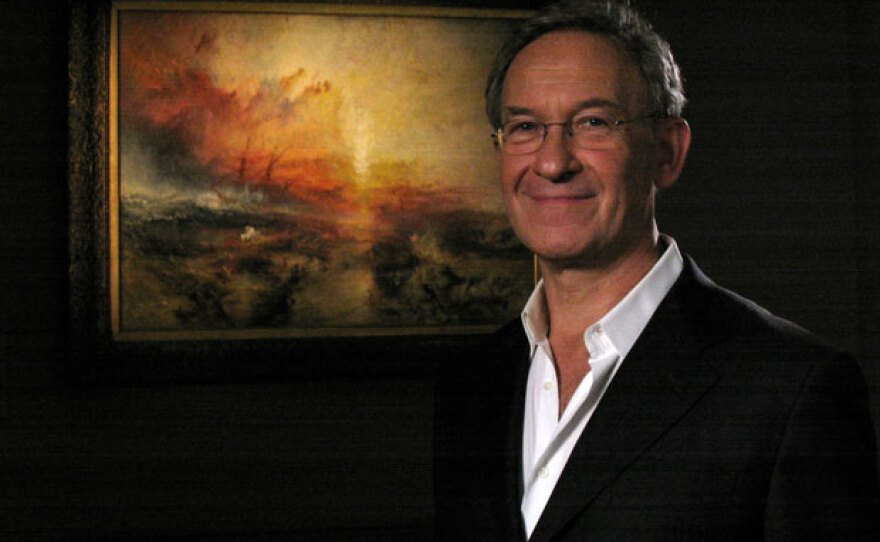
Neville Kidd, ©BBC
Airs Th, June three, 2010 at 11 p.m. on KPBS TV
Simon Schama On Turner
"In 1840 in London, an international convention of the Slap-up and Good was planned to express righteous indignation against slavery in the United States. Turner, initiated into the cause many years before past his patron, Walter Fawkes, wanted to have his say in paint. So how does he exercise it? Past being a thorn in the side of self congratulation. He reaches back 60 years to resurrect one of the well-nigh shameful episodes in the history of the British Empire when 132 Africans - men, women and children, their easily and feet fettered - were thrown overboard into the shark infested waters of the Caribbean. And Turner has drowned you in this moment, pulled you into this terrifying chasm in the ocean, drenched you in this bloody light - exactly the hue you sense in your blood filled optic nerves when yous close your optics in blinding sunlight. Though almost all of his critics believed that the painting represented an all time low in Turner'south reckless disregard for the rules of art, information technology was in fact his greatest triumph in the sculptural carving of space."
In 1840, Joseph Mallord William (J.M.West) Turner was 65, an erstwhile human being with sinking spirits, often sick, facing the bleak sea. Turner was off somewhere, voyaging way across any kind of painting the world had e'er seen, tempests of burning color, forms that had no discernible shape or line, subjects that imploded in sprays of brilliant oil, or swelling and ebbing washes of watercolor. He could get away with these wild atmospherics when the subject was topical or patriotic -"The Burning of the Houses of Parliament" or "The Fighting Temeraire." But he was too brave to play information technology condom and in also much of a hurry, existence one-time and frail.
When Turner died, lx of the great roiling seascapes were left unsold in his studio. Merely "Slave Transport (Slavers Throwing Overboard the Dead and Dying, Typhoon Coming On)" belonged to John Ruskin, who had been given it equally a present by his father. In 1843, Ruskin published his hymn of praise to Turner called "Mod Painters." Turner had anticipated the great 19th-century question posed by the invention of photography. If the camera could at present make two-dimensional facsimiles of nature, of people, of places, what work did that leave for art? Turner's neat nebulae of color gave one reply, merely there was another to be had.
Freed from the chore of describing the mere look of the world, art could at present get to the heart of the affair, the subjective vision of our mind's center. Turner was the first true modern. Modern were his tempests of pigment, modernistic his blown-upwards cloudy forms. Ultra-modern was his conclusion to tackle dangerous subjects - slave traders who threw bodies overboard to be rid of incriminating evidence when pursued by the Imperial Navy, or (as in the notorious instance of the ship "Zong" in 1783) to collect on the insurance for "lost holding" (the sick and the dying). For Turner, art was non a placebo. It needed to wreak havoc like the storm, to have the forcefulness of an avalanche or an inferno. Great painting, his painting, needed to chance disaster, the ameliorate to communicate it.
Lookout man video excerpts from the Tv set serial online.
Video Extract: Interview With Simon Schama
Source: https://www.kpbs.org/news/arts-culture/2010/06/02/simon-schamas-power-art-turner
0 Response to "Number of Pages Inthe Power of Art Simon Schama"
Post a Comment